The skills the AI era demands have always been at the heart of TLH
A Learning Policy Institute article argues that schools must be redesigned to build critical thinking, creativity, and problem-solving. At The Learning Habitat, those skills have never been an add-on — they are how our students learn every day.
In May 2025, the Learning Policy Institute published “Educating in the AI Era: The Urgent Need to Redesign Schools,” by Linda Darling-Hammond. The article makes a case that is hard to argue with: the factory model of schooling — students moved from room to room in 45-minute blocks, stamped with disconnected lessons — was designed a century ago and no longer fits the world young people are growing into.
The rise of AI makes the problem sharper. As routine work is automated, the skills that remain distinctly human — and most valuable — are the ones machines cannot easily replicate. The article points to what Google’s leadership calls “learning ability” as the strongest predictor of success in that environment:
The ability of students to find, analyze, and use resources to answer questions and design solutions; apply knowledge using judgment; evaluate and improve their own work; and effectively deploy advanced problem-solving skills, literacies, and dispositions.
Read that definition again, and you will find a description of what Learning Habitat students practice daily.
Critical thinking, creativity, and problem-solving are not a response to AI. They are a response to children.
Long before “redesign” became a national conversation, we built our programs on the conviction that children learn best by doing: asking real questions, working with their hands, testing ideas, revising their thinking, and creating something that matters to them. The world has caught up to what good educators have always known.
What the research calls for is what our classrooms already do
Find, analyze, and use resources
TLH students investigate real questions — in the creek, in the garden, in books, and in their communities. Research is not a unit; it is a habit built into hands-on, inquiry-driven lessons.
Apply knowledge using judgment
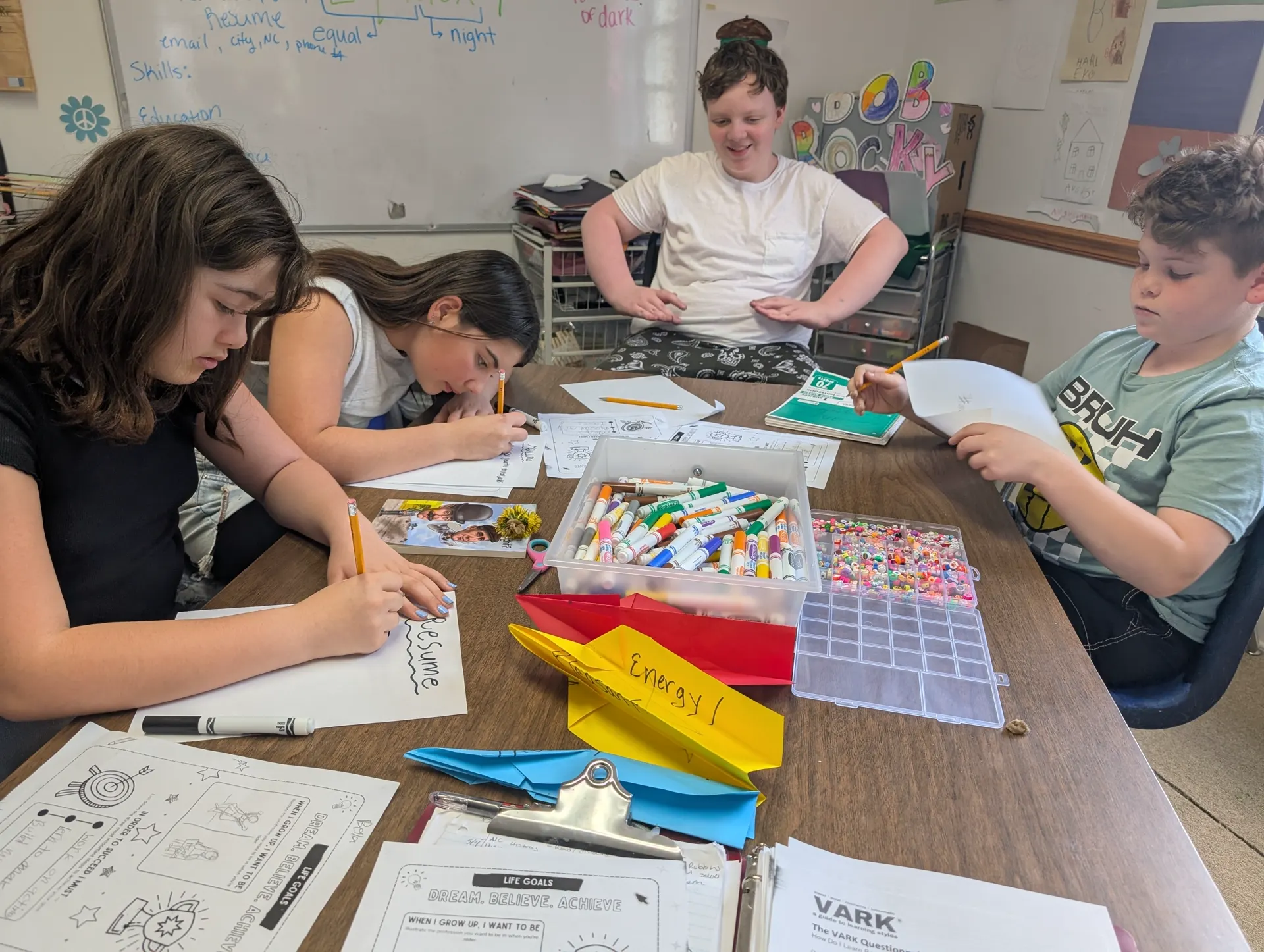
Differentiated, project-based work asks students to use what they know in new situations, weigh options, make decisions, and defend their reasoning — not just recall facts for a test.
Evaluate and improve their own work
Small classes make genuine feedback possible. Students draft, reflect, revise, and try again, learning to see their own work with a critical eye and take pride in making it better.
Deploy problem-solving skills and dispositions
Persistence, curiosity, collaboration, and flexibility are practiced daily — through challenges in the Forest Immersion Program, group projects, creative coursework, and the freedom to wrestle with problems that do not have one right answer.
Small, personal, and hands-on by design
The Learning Policy Institute article describes redesigned schools that share common features: smaller learning communities, strong relationships, project-based learning tied to real-world problems, and assessment that asks students to demonstrate what they can do rather than what they can recall.
Those features are not aspirations at TLH — they are our structure. Small classes mean every student is well known by their teachers. Creative and critical-thinking lessons give students real problems to investigate, build, discuss, and solve. Our Forest Immersion Program puts science, literacy, and problem-solving into the woods, where learning has texture, weather, and consequences. Field trips and community experiences connect classroom knowledge to the world students will actually live and work in.
When students learn this way, the question is never “will this be on the test?” It is “what can I figure out, make, or improve?” That is learning ability — and it is durable in a way memorized content is not.
What TLH students practice every day
- Critical and creative thinking
- Problem-solving and adaptability
- Research, analysis, and judgment
- Communication and collaboration
- Self-evaluation and revision
- Curiosity, confidence, and persistence
Preparing children for a changing world starts with how they learn, not what they memorize
No one can predict exactly which careers today’s students will hold. But the evidence is consistent: the students who thrive will be the ones who can think critically, create boldly, communicate clearly, and solve problems they have never seen before.
Developing those capacities has always been the point of a Learning Habitat education. The national conversation about redesigning schools is welcome — and for our families, it is also confirmation that the path we chose from the beginning is the right one.
Source
Darling-Hammond, L. (2025, May 30). Educating in the AI Era: The Urgent Need to Redesign Schools. Learning Policy Institute.