Outdoor learning and child development: What new research suggests
A recent Texas A&M report adds to the evidence that nature-based education can support academic development without separating learning from movement, exploration, and well-being.
A 2026 Texas A&M University article reports that children who learn in nature-based settings may experience benefits across several developmental domains, including early literacy, physical health, and social-emotional development. The article summarizes research led by Dr. Arianna Pikus, an assistant professor in the university's College of Education and Human Development.
The central finding is not that outdoor time replaces academic instruction. Rather, the evidence indicates that nature can function as a meaningful context for instruction. In a well-designed program, literacy, reasoning, self-regulation, movement, and social interaction can develop within the same learning experience.
What the researchers examined
- The peer-reviewed study was published in AERA Open in 2025.
- Researchers directly assessed school-readiness skills among 82 children in a nature-based preschool and compared their development with children in a non-nature preschool setting.
- The measured domains included early literacy and selected executive-function skills.
- The findings indicate that a nature-based setting is compatible with meaningful growth in foundational academic and developmental skills.
Literacy is not confined to a desk
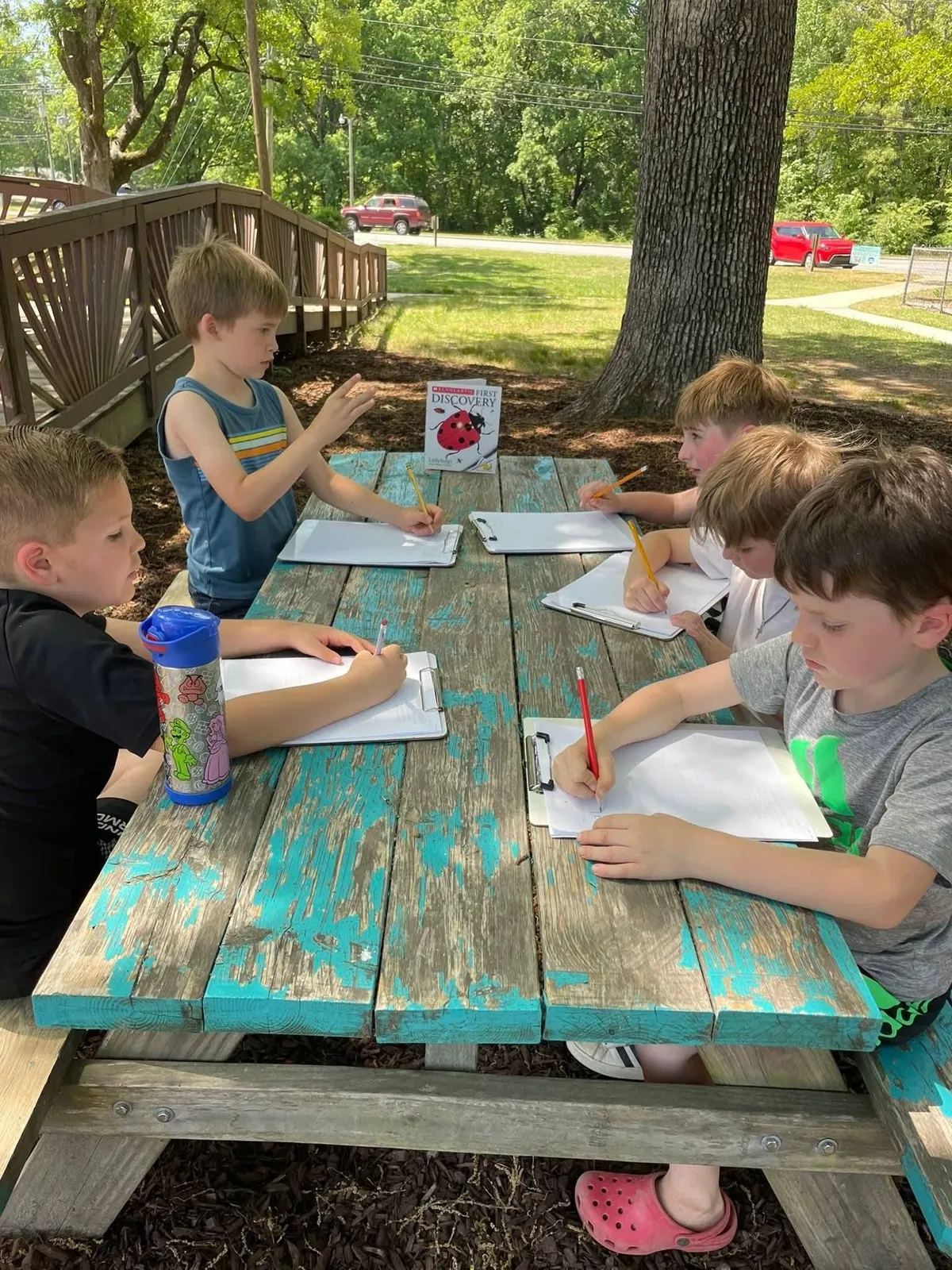
Early literacy develops through repeated opportunities to listen, speak, identify symbols, connect sounds with print, and communicate meaning. Outdoor environments can provide concrete subjects for those processes: children can describe an observation, record a change, follow written directions, compare evidence, or explain a conclusion.
Pikus describes these opportunities as potentially more authentic and meaningful than equivalent tasks presented only in a traditional setting. That distinction matters. A learning environment does not become less rigorous when students move outdoors; its academic value depends on whether educators connect experience to clear instructional goals.
Development occurs across connected systems
The Texas A&M report places literacy within a broader developmental framework. Nature-based education was associated with physical-health and social-emotional benefits as well as academic development. This is consistent with a whole-child model: attention, movement, emotional regulation, peer interaction, and cognition influence one another during learning.
The report also notes that researchers are still working to separate the effects of reduced outdoor time from the effects of increased screen exposure. That uncertainty is important. Scientific evidence should be interpreted as a developing body of knowledge, not as a single-variable explanation for every behavioral or academic outcome.
Potential benefits extend to educators
Pikus is also collaborating on research concerning outdoor programs and teacher well-being. According to the Texas A&M report, early results suggest that teachers who spend more time outside during the school day report lower stress, greater well-being, and less burnout.
These findings are preliminary and should not be treated as proof that outdoor instruction alone resolves workforce challenges. They do, however, identify the learning environment as a variable worthy of further study when schools consider teacher sustainability and retention.
Promising evidence, interpreted carefully
Research comparing existing educational settings can reveal meaningful patterns, but it does not establish that the setting caused every observed difference. Program quality, curriculum, teacher preparation, frequency of outdoor instruction, and family characteristics may also influence outcomes.
The responsible conclusion is therefore measured: nature-based education can support literacy and selected executive-function development while also creating opportunities for physical and social-emotional growth. Continued research should examine which practices are most effective, for which learners, and under what conditions.
Outdoor learning should deepen the curriculum
At The Learning Habitat, outdoor learning is one of our classrooms, not a substitute for the fundamentals. Reading, writing, mathematics, science, and critical thinking remain purposeful and explicit. The outdoor environment gives students additional ways to observe, question, practice, apply, and communicate what they are learning.
The Texas A&M findings reinforce an important principle: academic depth and whole-child development do not have to compete. When instruction is intentional, movement and nature can become part of a rigorous learning design.
Sources
- 1. Kolster, V. (2026, February 11). Outdoor learning linked to gains in literacy, well-being for children and teachers, Texas A&M study finds. Texas A&M University.
- 2. Pikus, A. E., Skibbe, L. E., Larimore, R. A., & Sobel, D. (2025). Investigating Nature-based Preschoolers Gains in Early Literacy and Select Executive Function Skills. AERA Open. DOI: 10.1177/23328584251362714.